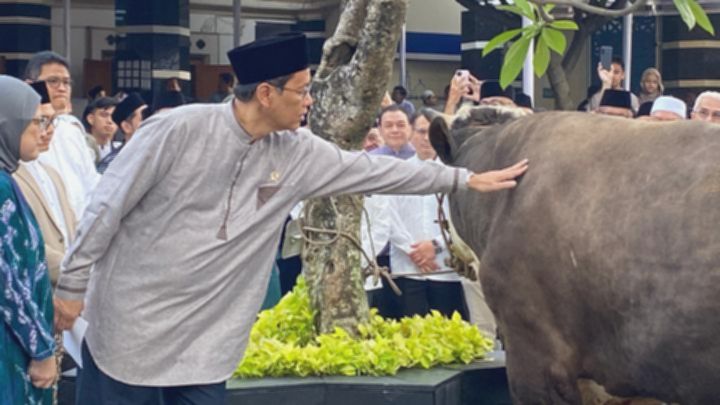

Finance Minister Purbaya Yudhi Sadewa joined the solemn observance of Idul Adha 1447 Hijriah prayers alongside Ministry of Finance staff at the Salahuddin Mosque, located within the Directorate General of Taxes (DGT) headquarters in Jakarta. During this significant occasion, Minister Sadewa personally presented a substantial 868-kilogram sacrificial cow to the mosque committee. This animal is destined for ritual slaughter and subsequent distribution to eligible members of the community, embodying the spirit of Qurban.
Following the congregational prayers, the nation’s chief financial steward clarified that the funds for the impressive Simental Crossing cow donated at the DGT office originated entirely from his personal finances. This generous contribution was augmented by another sacrificial cow, also funded from his private resources, which was offered at Minister Purbaya’s personal residence in Ciganjur.
Minister Purbaya further elaborated that the resources allocated for these sacrificial animals were derived from a bonus he had received, combined with savings initially earmarked for his 2026 Hajj pilgrimage, which unfortunately had to be cancelled. “The one at home was also from personal funds; there was a decent bonus, you see. So, we utilized it here. And then the Hajj didn’t happen, so it was all gathered here,” Purbaya stated after the Idul Adha prayers on Wednesday, May 27, 2026.
Indeed, Minister Purbaya had been scheduled to undertake the fifth pillar of Islam this year, a plan that, regrettably, was deferred. Expressing his sentiments, he shared, “It’s sad, but it wasn’t meant to be. Hopefully, I will be able to go next year.”
Seizing the moment, Minister Purbaya conveyed a profound message, emphasizing that Idul Adha transcends a mere annual ritual. Instead, he highlighted its role as a crucial opportunity to fortify the sense of humanity and advance social justice. The sacrificial animals distributed on this auspicious day, he noted, stand as a powerful symbol of a collective commitment to sharing, particularly with those most in need.
The Minister, who was appointed in September 2025, additionally underscored the deep correlation between the spirit of sacrifice and the responsibilities of those serving as custodians of the nation’s finances. He stressed the importance of refining social sensitivity to ensure that the managed State Budget (APBN) is strategically directed towards enhancing public welfare, with a particular focus on supporting vulnerable groups.
This year, the Ministry of Finance demonstrated its collective commitment by distributing a total of 486 sacrificial animals for Idul Adha. This substantial offering comprised 262 cows and 224 goats, pooled from the voluntary participation of 1,790 employees across various Echelon I units nationwide. The Ministry affirmed that the distribution of the Qurban meat would be meticulously targeted, facilitated through collaborative efforts with official zakat institutions and mosque committees in each respective locality.
Editor’s Choice: Conditions for Next Year’s State Budget Deficit to Be 2.4 Percent
Summary
Finance Minister Purbaya Yudhi Sadewa donated an 868-kilogram sacrificial cow at the Salahuddin Mosque for Idul Adha prayers, with another offered at his personal residence. He confirmed that both contributions were funded entirely from his personal finances. These funds comprised a bonus and savings initially earmarked for his 2026 Hajj pilgrimage, which had to be cancelled. Minister Purbaya expressed his regret over deferring the Hajj but hopes to undertake it next year.
Minister Purbaya highlighted Idul Adha as a vital opportunity to strengthen humanity and advance social justice, emphasizing sharing with those most in need. He connected the spirit of sacrifice to the responsibility of financial custodians in directing the State Budget towards public welfare, especially for vulnerable groups. The Ministry of Finance collectively distributed 486 sacrificial animals this year, sourced from 1,790 employees, ensuring targeted distribution through zakat institutions and mosque committees.