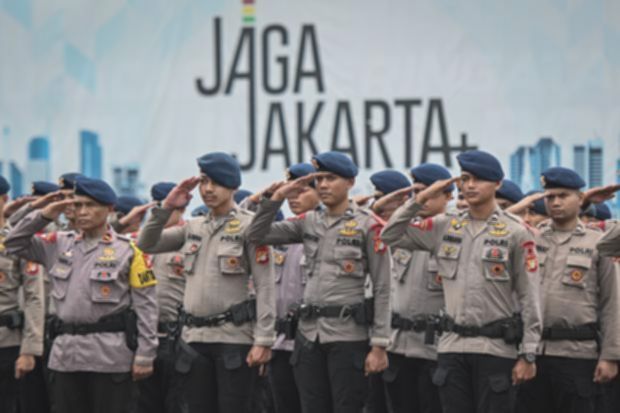

Discussions surrounding a proposed extension of the retirement age for Indonesian police officers from 58 to 60 years are gaining traction amidst revisions to the National Police Law. Minister of Law, Supratman Andi Agtas, asserts that the principle of fairness underpins this proposed change.
Supratman highlights that the retirement age for general civil servants (ASN) is already 60, and for those in functional positions, it’s 65. He argues that extending the police retirement age aligns with the increasing life expectancy in Indonesia, suggesting that people are now living longer, more productive lives.
“This means our productive age is also getting longer. Furthermore, we need to consider the time required to train high-quality law enforcement officers. Therefore, extending the retirement age for police personnel is based solely on the aspect of fairness,” Supratman stated at the Parliament Complex in Senayan, Jakarta, on Monday (25/5).
Data from the Central Statistics Agency (BPS) indicates that the national life expectancy for men reached 70.32 years in 2024. For women, the national life expectancy stands at 74.21 years.
This represents an increase from 2014, when male life expectancy was 68.87 years. Similarly, female life expectancy saw a rise of 1.62 years from 72.59 years in 2014.
Moreover, Supratman revealed that the draft revision of Law No. 2 of 2002 concerning the Indonesian National Police (RUU Polri) includes provisions for the head of the police institution to potentially serve until the age of 63. This extension could be granted through a presidential decree, allowing for a maximum tenure extension of 3 years.
Supratman clarified that this clause does not automatically grant a three-year extension. Instead, the police chief’s tenure extension would be subject to an annual evaluation before any further renewal.
“It’s possible that the president, whoever it may be, could decide to extend the tenure if they deem the individual is still needed by the state. However, this draft has not yet been finalized by the government,” he added.
However, policing observer Bambang Rukminto from the Institute for Security and Strategic Studies (ISESS) suggests that the revision of the National Police Law should prioritize public interest over institutional interests.
“The public might perceive this as driven by specific political maneuvers, as there appears to be no urgent need to increase the retirement age for police personnel,” Bambang commented during a phone interview on Monday (20/5).
The proposed revision to the National Police Law would amend the retirement age from the current 58 to 60 years. Additionally, police members with specialized skills would be eligible to retire at 65.
Instead of extending the retirement age, Bambang proposed considering the recruitment of Contract-Based Government Employees (P3K), general ASN, or non-ASN government employees to fill functional and administrative roles within the National Police. These options are already outlined in Article 20 of Law No. 20 of 2023 concerning ASN.
Bambang further explained that the ASN Law allows ASN employees to occupy positions within the TNI and Polri based on their required competencies.
“For instance, if the revision were to address the addition of personnel, that would be reasonable. However, extending the retirement age is not,” he concluded.
Summary
Discussions are advancing to extend the retirement age for Indonesian police officers from 58 to 60 years, with Minister of Law Supratman Andi Agtas citing fairness as the primary consideration. He argues this aligns with general civil servant retirement ages and reflects Indonesia’s increasing life expectancy. The draft revision also includes a provision for the police chief’s tenure to be potentially extended up to 63 years through a presidential decree, subject to annual evaluation. Additionally, police members with specialized skills would be eligible to retire at 65.
Conversely, policing observer Bambang Rukminto from ISESS suggests the revision should prioritize public interest over institutional interests, questioning the urgent need for such an extension. He proposes that the National Police instead consider recruiting Contract-Based Government Employees (P3K) or general civil servants for functional and administrative roles. This alternative aligns with existing ASN Law provisions that allow for external personnel to fill positions based on required competencies.