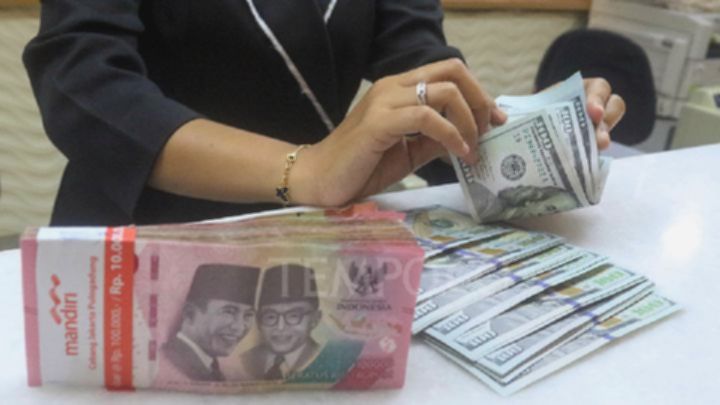

The Rupiah exchange rate concluded Wednesday’s trading session significantly weaker, depreciating by 127.5 points or 0.71 percent to settle at Rp17,966 per US Dollar. This sharp decline brings the Indonesian currency closer to the psychological Rp18,000 threshold, raising concerns among market participants.
According to money market observer Ibrahim Assuaibi, the Rupiah’s weakening trend is primarily influenced by a confluence of both adverse global and domestic sentiments. These intertwined factors are creating a challenging environment for Indonesia’s currency.
On the global front, investors remain highly attuned to the escalating Middle East conflict. Tensions have intensified following Israel’s continued military operations in southern Lebanon, while reports emerged of Iran launching ballistic missiles towards Kuwait and Bahrain, further destabilizing the region.
“Another round of talks involving Israel and Lebanon was scheduled for Wednesday, while uncertainty persists regarding negotiations between Washington and Tehran,” Ibrahim stated in his commentary in Jakarta on Wednesday, June 3, 2026, as quoted by Antara. This highlights the delicate diplomatic efforts attempting to de-escalate the volatile situation.
Adding to the geopolitical unease, Iranian media reports indicating a lack of communication between Tehran and Washington in recent days have fueled speculation that these crucial negotiations have reached an impasse, contributing to market apprehension.
Simultaneously, a surge in global oil prices is stoking fears of broader global inflation. This development has, in turn, intensified speculation that the US central bank, the Federal Reserve (The Fed), will be compelled to maintain its high interest rate policy for an extended period to curb inflationary pressures.
Further reinforcing this expectation, data released on Tuesday, June 2026, revealed an unexpected increase in US job openings in April 2026. This robust labor market performance suggests ongoing economic strength, which could give the Fed more leeway to keep monetary policy tight.
Such conditions have firmly bolstered expectations that the US central bank will adhere to a stringent monetary policy stance, making future interest rate cuts less likely in the near term. Consequently, market participants are now eagerly awaiting several key US economic data releases, including the ADP employment report, the ISM services sector index, and factory orders data. These will provide crucial clues regarding the Fed’s policy direction ahead of the highly anticipated nonfarm payrolls report on Friday, June 5, 2026.
Domestically, Ibrahim noted that sentiment towards the Rupiah has deteriorated following the release of Indonesia’s inflation figures for May 2026, which registered a month-to-month (mtm) increase of 0.28 percent. This figure is notably higher than the 0.13 percent inflation recorded in April 2026, signaling rising price pressures within the economy.
The uptick in inflation was primarily driven by several factors: volatile food prices, rising energy costs, government-administered prices, and the ongoing depreciation of the Rupiah itself, creating a challenging economic environment for consumers.
Despite these inflationary concerns, Indonesia’s trade balance continued its impressive run, recording a surplus of US$89.1 million in April 2026. This achievement extends Indonesia’s streak of consecutive trade surpluses to 72 months, a trend maintained since May 2020, underscoring the nation’s robust external resilience.
According to data from the Central Statistics Agency (BPS), the April 2026 trade surplus was predominantly supported by the strong performance of the non-oil and gas sector, which posted a surplus of US$3.53 billion. This highlights the diversification and strength of Indonesia’s export base.
However, Ibrahim cautioned, “Statistically, the April trade surplus narrowed sharply, underscoring pressure on purchasing power and external resilience due to global supply disruptions resulting from the Strait of Hormuz being blockaded by Iran’s Revolutionary Guard, with no clarity on when it will reopen.” This significant caveat indicates vulnerabilities despite the headline surplus figures.
Looking ahead to Thursday, June 4, 2026, Ibrahim projects that the Rupiah exchange rate will exhibit volatility, trading within a range of Rp17,960 to Rp18,030 per US Dollar as market forces react to the evolving global and domestic landscape.
Editor’s Choice: How Purbaya Curbs Deficit Without Halting Prabowo’s Projects
Summary
The Indonesian Rupiah depreciated significantly by 0.71% to Rp17,966 per US Dollar on Wednesday, nearing the psychological Rp18,000 mark. This weakening is attributed to adverse global and domestic sentiments. Globally, escalating Middle East conflict, rising oil prices, and expectations of the US Federal Reserve maintaining high interest rates due to strong US job data contributed to the decline.
Domestically, Indonesia’s May 2026 inflation rose to 0.28% month-to-month, signaling increased price pressures. Although the nation recorded a trade surplus in April 2026, it narrowed sharply due to global supply disruptions like the Strait of Hormuz blockade, indicating external resilience pressures. The Rupiah is expected to remain volatile, trading between Rp17,960 and Rp18,030 against the US Dollar on Thursday.