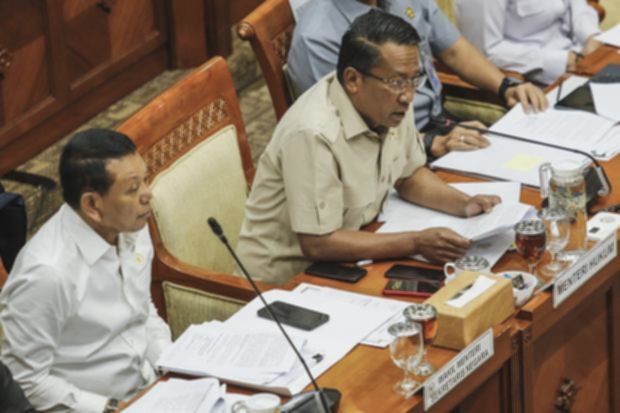
The Indonesian government anticipates a swift process for revising the Law concerning the Indonesian National Police (RUU Polri). Minister of Law, Supratman Andi Agtas, indicated that the proposed amendments will not introduce extensive changes.
He explained that many public aspirations regarding police reform have already been incorporated into the new Criminal Code (KUHP), enacted as Law Number 1 of 2023. Supratman elaborated that the comprehensive revisions to the Criminal Code in recent years included aspects of oversight for prosecution outcomes, a move supported by civil society coalitions. Consequently, the existing legislation now outlines how the police should execute their duties as security forces, particularly in law enforcement.
“This is why the changes within the Police Bill are not substantial,” Supratman stated at the Parliament Complex in Senayan on Monday (25/5). “However, some recommendations previously made are being considered by our colleagues in Commission III of the House of Representatives, and these are reflected in the draft Police Bill we have received.”
Based on this, Supratman expressed optimism that the revised Police Law could be officially enacted this year. This statement followed the government’s formal postponement of submitting its List of Inventory Problems (DIM) to parliament during a working meeting with Commission III of the House of Representatives earlier that day.
Supratman confirmed he had reviewed the draft Police Bill prepared by Commission III. The next step involves the government submitting its DIM, which will then be discussed. However, he noted that the DIM could not yet be submitted as the academic paper, serving as supporting documentation, is still under development. He estimates that the DIM discussion will commence after the 2026 Eid al-Adha holiday, likely next month.
Key points slated for discussion in the Police Bill revision, according to Supratman, include personnel and salary aspects. He emphasized that the primary focus will be on reinforcing the police’s role as a state instrument for maintaining security, public order, and law enforcement.
“The National Police is already undertaking reform efforts, both internally and through improved governance. Furthermore, investigation processes and other related matters are certain to see improvements moving forward,” he added.
Supratman reiterated his confidence in a rapid deliberation process for the Police Bill, noting that only 11 articles are slated for amendment. He anticipates that the number of DIM points submitted will be manageable, with fewer than 10 topics. He believes these 11 amended articles will contribute to a more professional, transparent, and accountable police force.
“We may accept the draft Police Bill as is, or there might be substantive changes. However, I believe the overall content revisions will not be extensive,” he remarked.
Previously, police observer Bambang Rukminto from the Institute for Security and Strategic Studies (ISESS) suggested that the revision of the Police Law should prioritize public interest over the institution’s. This perspective was shared in response to discussions about potentially extending the retirement age for police officers to 60.
“The public might perceive the revision as driven by specific political interests, especially since there’s no apparent urgency to extend the police’s retirement age,” Bambang commented via phone on Monday (20/5).
He argued that extending the retirement age for police personnel is not a pressing need. Instead of focusing on retirement age, he proposed that the government and the House of Representatives consider utilizing contract-based government employees (P3K), civil servants (ASN), or non-ASN staff to fill functional and administrative roles within the police force.
Beyond this, Bambang expressed support for provisions that would strengthen external oversight mechanisms, particularly the National Police Commission (Kompolnas). He stressed that internal oversight alone is insufficient. External bodies, he argued, require robust authority to prevent conflicts of interest and ensure accountability, especially concerning surveillance activities and the police’s responsibility to the public.
According to Bambang, the current oversight and control functions within the National Police are predominantly handled internally. He believes that governmental bodies like Kompolnas still need to be empowered to enhance police oversight and development, thereby safeguarding the independence and professionalism of the police.
“As an institution vested with significant state authority, the absence of strong external oversight could lead to conflicts of interest,” he concluded.
Summary
The Indonesian government expects to expedite the discussion and revision of the Law concerning the Indonesian National Police (RUU Polri) after the Eid al-Adha holiday. Minister of Law, Supratman Andi Agtas, stated that the amendments will be minor, as many public aspirations for police reform have already been integrated into the new Criminal Code. The focus of the bill will be on personnel and salary aspects, reinforcing the police’s role in maintaining security and public order.
The government anticipates a swift deliberation process, with only 11 articles slated for amendment and fewer than 10 List of Inventory Problems (DIM) points. This rapid progress is expected to foster a more professional, transparent, and accountable police force. However, some observers have suggested prioritizing public interest over institutional interests in the revision, particularly regarding the police’s retirement age, and advocating for stronger external oversight mechanisms like Kompolnas.