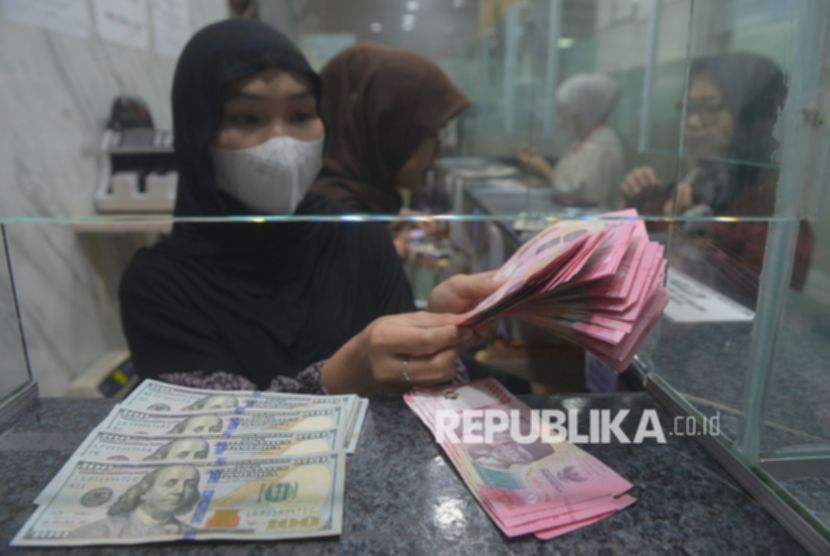

99 Tekno – JAKARTA — The Indonesian rupiah exchange rate concluded today’s trading session with a noticeable weakening, shedding 35 points or 0.20 percent to reach Rp 17,881 per US dollar, down from its previous close of Rp 17,846. This depreciation, according to money market observer Ibrahim Assuaibi, is primarily driven by the significant volatility in global oil prices.
“Oil prices have remained exceptionally volatile in recent sessions as markets react to conflicting headlines surrounding ceasefire negotiations,” Assuaibi stated in a written release in Jakarta on Friday. Market sentiment briefly improved after reports indicated that Washington and Tehran had reached a draft agreement to extend a ceasefire for 60 days, while discussions continued on Iran’s nuclear program and regional security issues.
The prospect of this ceasefire initially alleviated concerns over immediate supply shortages and fostered hopes that shipping activities through the strategic Strait of Hormuz could gradually return to normal. However, traffic through this critical waterway remains significantly below pre-conflict levels, ensuring that a geopolitical risk premium continues to influence the oil market.
Further influencing the rupiah’s performance were recent economic data from the United States. Figures concerning inflation and economic growth fell short of expectations, reinforcing the market’s anticipation that the Federal Reserve (the Fed) will likely maintain higher interest rates for a longer duration. Domestically, the Fed’s hawkish stance on interest rates has triggered a substantial capital outflow from emerging markets, including Indonesia.
“Investors are increasingly inclined to shift their assets towards lower-risk instruments in the US, such as bonds, which offer more attractive yields,” Ibrahim explained. Reflecting this broader trend, Bank Indonesia’s Jakarta Interbank Spot Dollar Rate (JISDOR) also registered a weakening today, moving to Rp 17,883 per US dollar from its previous level of Rp 17,789.
Rupiah Can Rebound if Global Pressures Ease
Looking ahead, there is a potential for the rupiah to experience a significant turnaround or rebound. Rahma Gafmi, a distinguished Professor at the Faculty of Economics and Business, Universitas Airlangga (Unair), projects that the rupiah could recover to a range of Rp 16,800 to Rp 17,200 per US dollar by the second half of 2026, provided several crucial determining factors are met. “Pinpointing the rupiah’s turning point largely depends on when external variables begin to cool down or abate,” Rahma stated in Jakarta on Friday. “However, from both technical and fundamental perspectives, several triggers could initiate a rupiah rebound.”
Rahma elaborated that the primary driver behind the US dollar’s current strength is the Federal Reserve’s interest rate expectations. The rupiah is poised to find its turning point if US economic data begins to show significant signs of cooling. “If unemployment figures in the US gradually rise and their inflation consistently settles below 3 percent, markets will once again bet on rate cuts,” she explained. “This would lead to a decrease in US Treasury yields, consequently attracting a fresh wave of capital inflow back into Indonesian government bonds (SBN), which currently offer highly attractive yields.”
Beyond interest rates, Bank Indonesia (BI) is actively leveraging instruments such as the Bank Indonesia Rupiah Securities (SRBI), which are continuously being strengthened. According to Rahma, the rupiah could strengthen if SRBI yields reach levels considered too lucrative for foreign investors to overlook. “Currently, with SRBI yields pegged at above 7.3 to 7.5 percent, the appeal for entering the domestic market will gradually build, thereby creating a new supply of dollars in the market,” she added.
Historically, pressure on the rupiah tends to intensify in the second quarter (April-June) due to foreign corporations in Indonesia actively converting rupiah to US dollars for dividend repatriation. This seasonal pressure typically eases as July and August commence. “If there are no negative surprises on the fiscal front, the rupiah naturally has room to strengthen as corporate demand for dollars declines. But conversely, if there are negative fiscal surprises, the rupiah will continue to be pressured,” Rahma warned.
She also noted the existence of specific psychological levels that prompt BI to intervene aggressively to safeguard the rupiah’s credibility. Should foreign exchange reserves be deemed sufficiently robust to manage volatility, speculators are likely to engage in profit-taking, which can rapidly trigger a rupiah appreciation.
As a commodity-exporting nation, Indonesia’s rupiah strengthening is also contingent on energy price stability, Rahma emphasized. If tensions in the Middle East de-escalate and global crude oil prices retreat to the range of 75 to 80 US dollars per barrel, the burden of energy imports would diminish, thereby supporting Indonesia’s trade balance.
According to Rahma, monetary authorities and the government typically pivot towards more structural measures if interest rate hikes prove ineffective in curbing rupiah pressure. One such measure involves strengthening regulations around natural resource export proceeds foreign exchange (DHE), which mandate exporters to place their foreign exchange earnings within the domestic financial system. Additionally, BI is expected to continuously enhance the attractiveness of SRBI instruments with competitive yields to draw in foreign capital flows. Other efforts include expanding local currency transactions (LCT) and developing non-dollar instruments to temper the demand for US dollars in the domestic market.
On another front, Rahma suggested that the government could also contribute to rupiah stability by curbing non-essential imports or postponing projects with a high import component. However, she cautioned that if markets perceive geopolitical tensions as persistently escalating or the state budget deficit widening unsustainably, administrative policies like DHE obligations could paradoxically be viewed as an emergency signal, potentially triggering investor anxiety. “While these steps appear robust on paper, their effectiveness often clashes with market psychology,” Rahma concluded.
Summary
The Indonesian rupiah recently weakened to Rp 17,881 against the US dollar, driven by significant volatility in global oil prices and uncertainty surrounding Federal Reserve interest rate policies. Persistent geopolitical risks in the Middle East and concerns over US inflation have prompted investors to favor safer assets, leading to capital outflows from emerging markets like Indonesia. Consequently, the currency has faced sustained downward pressure as markets anticipate higher-for-longer US interest rates.
Despite current challenges, experts suggest the rupiah could rebound by the second half of 2026 if US economic data cools and the Federal Reserve begins rate cuts. Stabilizing global energy prices, along with Bank Indonesia’s strategic use of domestic securities and export revenue regulations, are expected to provide support. While seasonal dividend repatriation remains a factor, the currency’s recovery largely depends on improved trade balances and a reduction in external macroeconomic pressures.