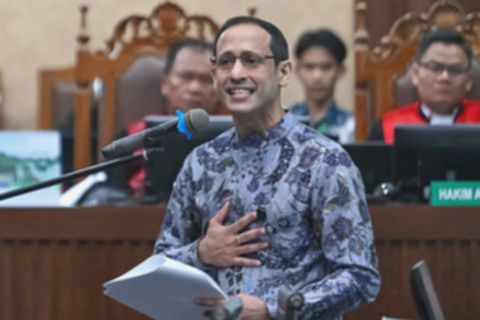

Former Minister of Education, Culture, Research, and Technology, Nadiem Makarim, recently recounted his harrowing experience of entering a detention cell for the first time, an ordeal stemming from an alleged corruption case involving the procurement of Chromebook laptops. His candid reflections emerged during the reading of his defense statement (plea) at the Jakarta Corruption Court on Tuesday, June 2nd.
During the court proceedings, Nadiem openly shared the profound psychological impact of his initial period of detention, particularly being placed in solitary confinement. He confessed that at that moment, the world felt as if it had utterly collapsed around him.
“In the early days of my detention, the world felt like it had ended. I was alone in isolated confinement, as if I had simply been cast aside,” Nadiem revealed emotionally as he delivered his plea.
He further admitted to experiencing frequent hallucinations and clinging to the hope that his dire situation was merely a bad dream.
“Sometimes I would wake up in the middle of the night in the detention facility, and for a fleeting moment, I would believe this was just a nightmare, and that my wife would wake me up soon. But what I saw instead were iron bars,” he continued, painting a vivid picture of his mental struggle.

Despite the immense pressure of his circumstances, Nadiem emphasized that he garnered invaluable lessons from the experience. These ranged from cultivating patience to completely surrendering himself to God.
“However, through this bitter experience, I gained so many insights. When freedom is stripped away, there’s nowhere else to venture but deep within ourselves. I learned to be patient, which was incredibly difficult for me. I learned to surrender myself to Allah in the darkest of times. And with the passage of time, slowly, I learned to quiet my mind,” Nadiem articulated.
Nadiem asserted that the most profound suffering endured in prison was not the loss of physical liberty, but rather the relentless burden of uncertainty regarding his fate.
“For those who haven’t experienced prison, the greatest torture isn’t the deprivation of freedom, but the uncertainty that haunts our minds from morning till night. How is my family? What will happen tomorrow? Does the world know what truly happened? The prison within our heads causes far more pain than the iron bars that lock us in,” he explained with palpable emotion.
In conclusion, Nadiem expressed his conviction that the experience of detention had provided him with an opportunity to discover renewed hope within himself.
“But it was in that darkness that I found a new light within me. Prison taught me to have faith in uncertainty. Because of that, I can stand here today, without fear, ready to face whatever Allah will bestow upon me,” Nadiem concluded powerfully.
This deeply personal narrative was shared during his defense statement pertaining to the alleged corruption surrounding the digital transformation project and Chromebook laptop procurement within the Ministry of Education, Culture, Research, and Technology between 2019 and 2022.
In a previous hearing, prosecutors had demanded an 18-year prison sentence for Nadiem, along with fines and restitution totaling an staggering Rp 5.6 trillion (approximately USD 345 million), alleging that his actions caused the state a loss of Rp 2.1 trillion (approximately USD 130 million).
Summary
Former Minister of Education, Culture, Research, and Technology, Nadiem Makarim, recently recounted his harrowing first experience in a detention cell during his defense statement at the Jakarta Corruption Court. He described the profound psychological impact of solitary confinement, feeling as though his world had collapsed and experiencing frequent hallucinations. Nadiem confessed to waking up hoping it was a nightmare, only to see iron bars.
Despite this ordeal, he emphasized gaining valuable lessons, including patience and surrendering to God. Nadiem asserted that the greatest torture in prison was the relentless uncertainty about his fate and family, rather than the loss of physical freedom. This experience ultimately provided him with renewed hope, as prosecutors demand an 18-year sentence for his alleged involvement in a corruption case concerning Chromebook procurement.