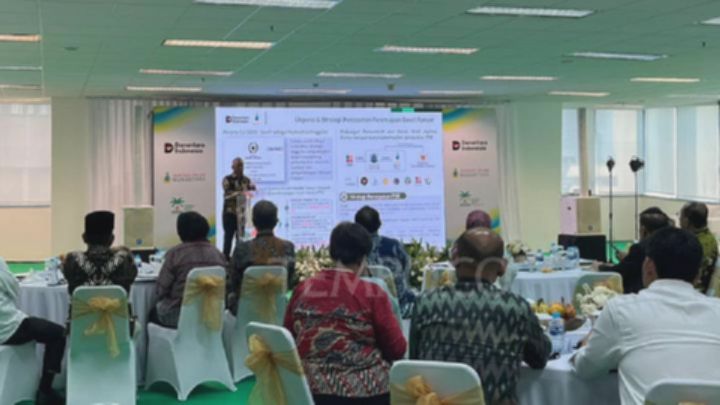

PT Agrinas Palma Nusantara (APN) has forged a strategic partnership with Universitas Gadjah Mada (UGM) to significantly enhance research capabilities, accelerate technology development, and uplift the quality of human resources. This collaborative endeavor is set to drive the transformation of Indonesia’s vital plantation sector and bolster national food security initiatives.
Mohammad Abdul Ghani, President Director of PT Agrinas Palma Nusantara, emphasized that a single entity cannot effectively manage millions of hectares of plantations spread across the vast Indonesian archipelago. Therefore, he stressed the critical importance of university involvement to introduce science-based innovations and reinforce the implementation of robust sustainability principles across operations.
“We currently manage approximately 4.11 million hectares of oil palm land, stretching from Aceh to Papua. Given this extensive coverage, we require comprehensive academic support through the university’s ‘Tridharma’ functions, encompassing research, technology development, and human resource capacity building,” Ghani stated at UGM on Saturday, May 30, 2026.
The scope of this pivotal collaboration, according to Ghani, extends beyond just oil palm. Looking ahead, the partnership is poised to expand its focus to support the development of other strategic commodities crucial for national food security, such as corn, soybeans, and cassava.
Ghani further highlighted that active farmer involvement is an indispensable factor in elevating the productivity of the plantation sector. Consequently, Agrinas is diligently promoting more sustainable partnership models that transcend mere transactional relationships.
“We are committed to building stronger, more enduring relationships with farmers. This approach aims to significantly boost their productivity and substantially narrow the gap with corporate productivity levels,” he remarked.
To achieve these ambitious targets, Agrinas has established two specialized directorates dedicated to addressing environmental and social sustainability aspects. Ghani explained that this organizational restructuring is an integral part of the company’s commitment to ensuring that all plantation business practices strictly adhere to core sustainability principles.
“We are formulating robust policies to ensure Agrinas operates as a company fully compliant with sustainability principles, both environmentally and socially. This proactive model is still relatively uncommon within the Indonesian plantation industry,” Ghani asserted, underscoring the company’s pioneering efforts.
Beyond critical research and technology development, Agrinas also plans to establish a state-of-the-art superior seed propagation center. Concurrently, the company is developing innovative digital systems designed to further enhance farmer productivity across its operations.
Professor Ova Emilia, Rector of UGM, warmly welcomed the partnership, aligning with the university’s vision. She articulated that the development of the plantation sector must be strategically guided by the principles of sustainable agriculture. This approach, she noted, not only seeks to increase production but also prioritizes the welfare of communities and the preservation of the environment.
“The true success of any program is not solely measured by production outcomes, but fundamentally by how effectively and sustainably it improves community welfare,” Ova emphasized.
UGM, she affirmed, stands ready to support the collaboration through its diverse academic disciplines, ranging from agriculture, economics, and social sciences to law. The university also offers opportunities for strengthening human resource capacity through tailored undergraduate and postgraduate programs designed to meet specific industry needs.
Moreover, the involvement of university students through the Community Service Program (Kuliah Kerja Nyata – KKN) is viewed as a powerful mechanism for empowering local communities residing in and around plantation areas.
The comprehensive cooperation between Agrinas Palma Nusantara and UGM also encompasses the development of innovative funding models for the university, supported by a portion of the company’s business profits. Both parties express strong optimism that this synergy will catalyze numerous innovations, ultimately strengthening the national plantation sector, significantly enhancing farmer welfare, and robustly supporting Indonesia’s overarching food security agenda.
Editor’s Choice: The State Budget’s Primary Balance Remains Negative. What Does It Mean?
Summary
PT Agrinas Palma Nusantara (APN) has forged a strategic partnership with Universitas Gadjah Mada (UGM) to enhance plantation research, accelerate technology development, and uplift human resources. This collaboration aims to transform Indonesia’s vast plantation sector, spanning 4.11 million hectares of oil palm, and bolster national food security. Agrinas stresses the critical need for science-based innovation and robust sustainability principles, planning to expand focus to strategic commodities like corn and soybeans. The company is committed to boosting farmer productivity through sustainable partnership models and has established specialized directorates for environmental and social sustainability.
UGM welcomes this partnership, aligning with its vision for sustainable agriculture that prioritizes community welfare and environmental preservation alongside production outcomes. The university will provide academic support across diverse disciplines, offer human resource capacity building programs, and involve students in community empowerment initiatives. This comprehensive cooperation also includes innovative funding models for UGM, supported by a portion of Agrinas’s business profits. Both parties express strong optimism that this synergy will catalyze numerous innovations, ultimately strengthening the national plantation sector, enhancing farmer welfare, and robustly supporting Indonesia’s food security agenda.