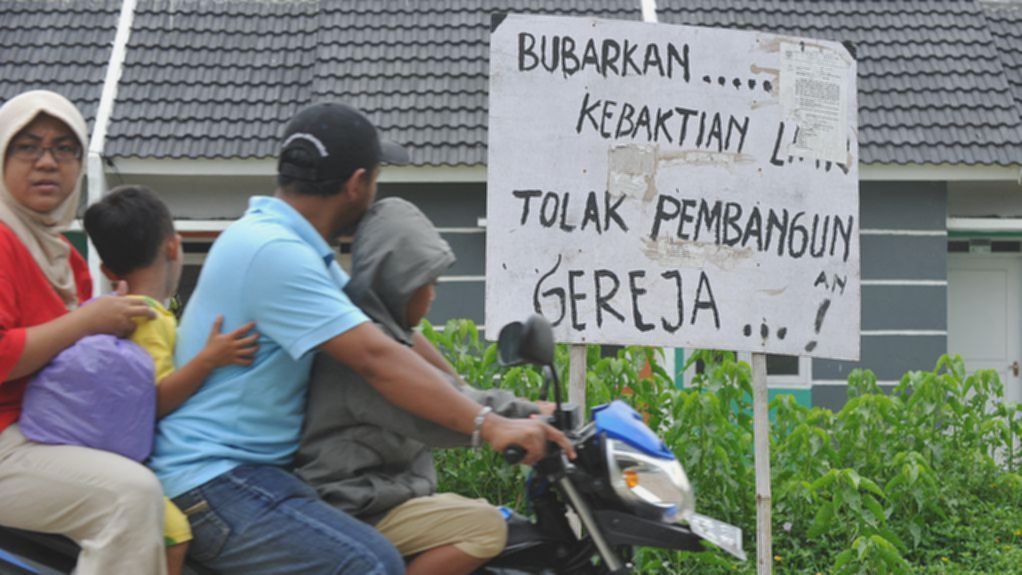

Members of the Islamic Jihad Forum (FJI) Yogyakarta forcibly dispersed worship activities of the Gereja Misi Sejahtera (GMS) congregation in Sewon, Bantul, on Sunday (May 24th). The disbandment was reportedly accompanied by “intimidation, as well as physical and verbal threats.”
This infringement on the freedom of worship and the establishment of places of worship is not an isolated incident.
Just two months prior, hundreds of individuals demanded the permanent closure of the prayer house belonging to the Persekutuan Oikoumene Umat Kristen (POUK) Tesalonika congregation in Teluknaga, Tangerang Regency.
Furthermore, throughout the previous year, the Setara Institute recorded a distressing 221 incidents of violations against freedom of religion or belief (KBB), affecting 239 victims across Indonesia.
Among these incidents, destruction, rejection, sealing, and prohibitions on worship and the establishment of places of worship consistently emerged as the most dominant patterns of violations.
This persistent pattern begs critical questions: Why do these violations continue to recur? Are existing regulations sufficient to prevent them, or do they, conversely, form the very root of these ongoing problems?
How do local residents view the presence of GMS?
Hundreds of people gathered along Jalan Wirjono Projodikoro, Bantul, Yogyakarta, on Sunday, May 24, 2026. They witnessed a group from the Islamic Jihad Forum (FJI) dispersing the Gereja Misi Sejahtera (GMS) congregation during their worship service.
Mbah Ipin, a local resident who operates a warung (small food stall) next to the GMS building, recounted the scene. “During the incident, I was indeed selling, serving customers. The warung was full of people buying snacks,” said the 61-year-old on Tuesday (May 26th).

Mbah Ipin admitted he learned about the issues concerning the place of worship from conversations with his customers. “The incident itself didn’t last long, about half a day. It was mostly those who were guarding and watching who stayed the longest,” he remarked. Having lived in Glugo Hamlet since birth, long before the GMS building was constructed, he shared his perspective.
Before this event, Mbah Ipin claimed he had never heard of a church next to his warung, believing the building to be a warehouse. However, he stated that he personally has no issue with a church being located there. “Worship is a basic human right, a conviction towards the creator. If it causes disturbance, then it’s not allowed. But as long as it doesn’t disturb anyone, it’s fine. Perhaps the people [protesting] are just envious or something, I don’t know,” he expressed.

Similarly, another resident of Glugo Hamlet, Zainar, also expressed no objection to the church’s presence in her area. She emphasized that everyone has the right to embrace a religion and worship according to their beliefs. “It’s not a problem. In Islam, it is said, ‘My religion for me, and your religion for you.’ What matters is that people are good, nice, and make the area lively. People can shop at my warung,” said the 65-year-old woman.
“And I’d be happy if it’s busy, hopefully, customers will come here. I would be delighted, God willing, if someone buys from my warung. I have no other thoughts,” she added. Zainar also confirmed her awareness that the GMS building was intended to be a church. She recalled, “Workers at the church used to eat here. I asked them where they worked, and they replied they were renovating the church west of the hospital.”
Conversely, a segment of local residents actively opposes the presence of GMS in their area. Among them is the head of RT 06, Glugo Kulon, who wished to remain anonymous. “From my side, I reject it; I do not agree. I also didn’t know it was a church,” he told Detik.com in Glugo, Bantul, on Tuesday (May 26th).
The RT head explained that initially, GMS Bantul only applied for a domicile permit for a foundation office, not a church. Given the mixed opinions from residents, BBC News Indonesia attempted to interview the head of Glugo Hamlet and the head of Panggungharjo village, but both declined to comment.

In response, the Acting Head of Kesbangpol (National Unity and Politics Agency) of Bantul Regency, Yulius Suharta, affirmed that citizens’ freedom to worship according to their religion and beliefs is guaranteed by the constitution. “If a group of people stops [worship], it becomes a multi-sectoral responsibility. Ensuring citizens can worship is a government commitment to enable its people to embrace religion and perform worship,” Yulius stated.
How did the GMS management and FJI chronicle the events?
Josiah Michael, Public Relations for GMS Central, recounted that dozens of individuals from the Islamic Jihad Forum (FJI) Yogyakarta arrived and forced the GMS Bantul to disband its worship activities at 7:59 AM WIB on Sunday (May 24th). Josiah added that their actions were accompanied by “alleged acts of intimidation and threats, both physical and verbal,” on Tuesday (May 26th). The worship service was ultimately forced to disperse following the disturbance. “This incident left deep wounds and trauma on the congregation, especially the children,” he revealed. “Restricting worship through intimidation that leads to violence is an act that injures the values of tolerance and national harmony,” he further emphasized.

Conversely, the Chairman of FJI DIY, Abdurrahman, acknowledged his organization’s presence at GMS. He stated that the action was taken after receiving reports from residents who rejected the establishment and planned inauguration ceremony of GMS in their area. “Yesterday, it escalated because the residents had already expressed their rejection. FJI also received reports, so we eventually went there,” Abdurrahman explained on Monday (May 25th).
Abdurrahman asserted that the presence of GMS in the area did not comply with regulations, specifically lacking a church establishment permit and facing rejection from residents. “If there’s a permit, residents should be asked for their signatures. This wasn’t done, and suddenly it was built, and then yesterday they were planning an inauguration,” he revealed. “If they indeed want to establish a church, then by all means, but it must follow procedure. Get permits from residents, signatures from residents. Right? If the residents don’t have a problem, then we also don’t have a problem,” he added.
How did the government respond?
Following the viral spread of the disbandment incident on social media, government officials promptly spoke out. The Regent of Bantul, Abdul Halim Muslih, vehemently condemned the acts of persecution and intimidation experienced by the GMS congregation. “Persecution and intimidation against worshippers performing their rituals are unacceptable and cannot be justified, neither from a religious nor a constitutional perspective,” he stated at the Manunggal Great Mosque in Bantul Regency.
After the incident, Abdul mentioned that his administration, alongside the Regional Office of the Ministry of Religious Affairs (Kanwil Kemenag DIY) and the Forum for Religious Harmony (FKUB), would follow up on the GMS permit application, in accordance with the Joint Regulation of the Minister of Religious Affairs and the Minister of Home Affairs (PBM) No. 9 and No. 8 of 2006. He added that while the permitting process is underway, the GMS building cannot be used for worship.

Meanwhile, the Bantul Police Chief, AKBP Bayu Puji Hariyanto, confirmed that his department is investigating the alleged disbandment and persecution of the GMS worship service. Prior to the incident, the Bantul Regional Government admitted to being aware of the planned mass movement towards GMS and had attempted to prevent it, but without success. “We tried to anticipate, but the fact is that a movement at the GMS activity site still occurred yesterday,” said Yulius Suharta, Acting Head of Kesbangpol of Bantul Regency.
Yulius explained that before worshipping in the GMS building, the congregation used to conduct their services by renting space in a hotel in Bantul Regency. Subsequently, he noted, GMS leased a building in Glugo Hamlet, located not far from the hotel. Following this, Yulius added, the GMS management proceeded to process a Certificate of Registration (SKTL) issued by the Kanwil Kemenag DIY. However, Yulius confessed he was unsure about the exact function of the SKTL. “Whether [SKTL] genuinely allows it to be used as a place of worship or if there are still other administrative procedures to complete,” he stated.

The Governor of DIY, Sri Sultan Hamengku Buwono X, also responded to the disbandment of the worship. “Human beings are bound to have differences. But they fail to understand that Allah indeed created different races, different religions, and different origins,” the Sultan remarked on Monday (May 25th). “So, difference is essentially an inevitability; it is His creation. No one is exclusively right,” he continued, advocating for mutual respect.
Chairman of the Nahdlatul Ulama Executive Board (PBNU), Ahmad Fahrur Rozi, also expressed deep concern over the incident of intolerance. “The incident of worship disbandment in Bantul is deeply regrettable and must not recur. Freedom of religion and worship is guaranteed by the constitution, thus all parties must prioritize tolerance, dialogue, and wise legal resolution,” stated Gus Fahrur on Tuesday (May 26th). Gus Fahrur emphasized that any administrative or permitting issues must be resolved through legal mechanisms and constructive communication, not through intimidation or forced disbandment.
A Recurring Issue
Approximately two months prior to the GMS incident, on Friday (April 3rd), hundreds of people converged on the prayer house of the Persekutuan Oikoumene Umat Kristen (POUK) Tesalonika congregation in Tangerang Regency, demanding its permanent closure. This incident underscores a worrying trend.
Indeed, throughout 2025, the Setara Institute meticulously recorded 221 instances of violations against freedom of religion or belief (KBB), affecting 239 individuals across Indonesia. The data paints a grim picture of persistent challenges to religious pluralism.

According to the Setara Institute, patterns of destruction, outright rejection, sealing of premises, and outright prohibitions on worship and the establishment of places of worship have become the most dominant forms of KBB violations in various regions. This highlights a systematic challenge to religious communities.
Below are several notable KBB cases previously documented by BBC News Indonesia, illustrating the breadth and depth of these issues:
- The forced disbandment of a retreat in Cidahu, Sukabumi;
- Attacks and destruction of a Christian prayer house in Padang Sarai, West Sumatra;
- Prohibition of the construction of a Toraja Church in Samarinda;
- Prohibition of the construction of a church in Cilodong, Depok;
- Prohibition of the renovation of St. Joseph Church, Karimun Islands, Riau Islands Province;
- Prohibition of the construction of HKBP Maranatha Church in Cilegon, Banten;
- Prohibition of the construction of GKI Taman Yasmin, Bogor;
- Prohibition of the construction of Filadelfia Church in Bekasi and Aceh Singkil Church;
- Prohibition of the construction of Batuplat Mosque in Kupang, East Nusa Tenggara, and As-Syafiiyah Musalla in Denpasar City, Bali;
- Prohibition of the construction of GBI Tlogosari in Semarang.
A study by Komnas HAM (National Commission on Human Rights) indicates that conflicts over places of worship were first officially recorded in 1967 with the establishment of a house of worship in West Aceh, subsequently followed by a long series of similar events. Halili Hasan, Executive Director of the Setara Institute, attributes this persistent series of KBB violations to “the continued existence of discriminatory and intolerant regulations targeting minority groups. These regulations are perpetuated to restrict the movement of minority groups in practicing their religious teachings and rituals.” This suggests that the legal framework itself may be contributing to the problem.
What do the regulations say about establishing places of worship?
The guidelines and requirements for establishing places of worship are stipulated in the Joint Regulation of the Minister of Religious Affairs and the Minister of Home Affairs (PBM) No. 9 and No. 8 of 2006. Prior to this, the governing regulation was the Joint Decree (SKB) of Two Ministers from 1969, which granted regional heads the authority to issue permits.
Article 14 of PBM 2006 elaborates that the establishment of a place of worship must fulfill administrative requirements, technical building requirements, and specific special requirements.
These special requirements mandate:
- A list of names and ID cards of at least 90 worshippers, certified by local officials;
- Support from at least 60 local community members, certified by the village head/lurah;
- Written recommendations from the head of the district/city religious affairs office, and written recommendations from the district/city FKUB (Forum for Religious Harmony).
Why are these regulations ‘problematic’?
Thowik, an activist for freedom of religion and belief from the NGO Serikat Jurnalis untuk Keberagaman (Sejuk), asserts that PBM 2006 serves as the fundamental source of the recurring violations of religious freedom. “PBM 2006 is the origin of discrimination against citizens’ rights to obtain permits for establishing places of worship, and automatically, their rights to worship,” Thowik stated, highlighting the regulation’s systemic flaws.
Echoing this sentiment, Bonar Tigor Naipospos, Deputy Chairman of the National Council of the Setara Institute, also believes that the intricate series of requirements within the PBM directly contributes to the perpetuation of these violations.
 The “60 support and 90 worshippers” rule
Bonar Tigor Naipospos, Deputy Chairman of the National Council of the Setara Institute, identifies the “60/90” requirement as the initial critical hurdle in the construction of places of worship. “Because often the community rejects it, or is provoked by certain parties, or simply the number of supporters isn’t sufficient. And even if they do get it, if there are community members who object, it can lead to further disputes. Ultimately, the permit process stalls,” Bonar explained, illustrating how this rule can easily become a point of contention.
Meanwhile, Thowik views the “60/90” rule as a fundamental basis for local government officials to exhibit favoritism towards the aspirations of the majority group. He cited examples: “There’s a case in one village where there are only 10 Muslim families, with the majority being Christian. But because of the 60/90 requirement, a church cannot be built due to insufficient support.” He added, “Then, in several areas in West Java, the Christian congregation met the numbers, but lacked support from the local community, which is predominantly Muslim. So, they couldn’t get a permit.”
A study by Komnas HAM further deemed these support requirements contradictory. On one hand, the government seeks to regulate “forum externum” (communal worship); on the other, the rule infringes upon “forum internum” (individual faith), which should ideally remain free from intervention. “This condition is reflected in the requirements for guaranteeing the right to worship in the context of establishing places of worship – it always requires approval from other citizens (congregations), through FKUB mechanisms and approvals, and authorized by the Regency/City Government,” the study elaborated. Komnas HAM concluded that, in effect, these requirements complicate the establishment of places of worship, particularly for minority groups. “The implication is that many religious communities are forced to worship in their respective places under an illegal or unlicensed status.”
 Multi-tiered permits and recommendations
The second major issue, according to Bonar, is the requirement for recommendations from various parties, which in some cases, becomes the very source of the permitting problems. Bonar noted instances where the “60/90” requirement was met, yet permits remained elusive due to a lack of recommendation from local RT officials. “For example, HKBP Ciketing, Bekasi. Community support was obtained, but it was the FKUB itself that refused to provide a recommendation,” Bonar stated. He highlighted a crucial ambiguity: “Yet, the PBM doesn’t clearly state whether the party providing the recommendation can refuse or not.”
Further examples include the POUK Tesalonika Church in Tangerang Regency and the Toraja Church in Samarinda, as cited by Thowik from Kabar Sejuk. Thowik explained that these churches had meticulously followed the PBM 2006 permit process. However, permits were consistently denied, hindered by outstanding recommendations from the FKUB, local government heads, and the departments responsible for Building Construction Approvals (PBG). “It becomes like an endless loop, ultimately leading to no permit,” Thowik lamented, describing the bureaucratic quagmire.
Alleged source of extortion
Thowik further suggested that the PBM’s demanding and allegedly discriminatory requirements have, in some instances, become a source of extortion. He elaborated on the mechanics of this suspected corruption. “To get 60 citizen endorsements, you have to visit each house individually. This often requires bringing something, whether it’s rice or envelopes,” he explained, pointing to the unofficial costs involved in securing community support.
He continued, “Then, the support must be verified by local officials, the lurah or village head. This also requires bringing something; otherwise, the process will be made difficult.” The alleged extortion does not stop there, extending to the relevant agencies when processing Building Construction Approvals (PBG). “I even received complaints where the amounts ranged from Rp200 million to over Rp1 billion,” Thowik revealed, indicating substantial financial demands. However, exposing such practices is challenging. “If exposed, their PBG permit could be revoked, and they would be accused of bribery,” Thowik concluded, highlighting the precarious position of those seeking permits.
What solutions can be taken?
Thowik asserted that the president possesses significant authority to resolve the ongoing issues surrounding places of worship. The proposed solution, he explained, involves revoking PBM 2006 and establishing a more progressive Presidential Regulation (Perpres) to govern the establishment of places of worship. This new Perpres, according to the Setara Institute, should fundamentally reinforce the guarantee of worship rights, rather than perpetuating a mechanism of social veto against religious and belief minorities.
“For example, the requirements should consider spatial planning, or the guarantee of worship. So, it shouldn’t be based on the approval of other people,” said Tigor, emphasizing objective criteria. Similarly, Komnas HAM also believes that regulations should ideally focus on objective requirements such as conformity with spatial planning, prohibition of places of worship for practical political activities, prevention of imprisonment or detention, and harmony with the surrounding regional landscape. “Ideally, the establishment of places of worship should not be burdened with requirements that are overly dependent on the subjectivity and approval of other parties,” the Komnas HAM study concluded, advocating for a more streamlined and equitable process.
Former Minister of Religious Affairs (Menag) Yaqut Cholil Qoumas had previously planned to remove the requirement for FKUB recommendations in the permitting process for establishing places of worship. This change was intended to be implemented following the issuance of a Presidential Regulation concerning the establishment of places of worship. “Then, the recommendation for establishing a place of worship would only require the Ministry of Religious Affairs; FKUB would be removed,” Yaqut stated on Saturday (August 3rd, 2024). The elimination was proposed, he said, because the FKUB recommendation had become a significant obstacle to the establishment of places of worship. However, this promising plan has yet to materialize.
—
Journalist Mustaqim in Yogyakarta contributed to this article.
- RT head becomes suspect for disbanding Lampung church worship: ‘Hoping intolerant groups will be deterred’
- ‘Residents have no objection to the presence of the Mary statue’ in Kulon Progo, Ministry of Religious Affairs and police deny organizational pressure
- Grieving during Easter after prayer house in Tangerang sealed – ‘There is fear, especially since our prayer house has a yellow sign’
- Case of disbandment of Catholic student worship at Pamulang University: RT head and three other residents named suspects
- Church establishment rejected: Netizens question mayor’s actions, ‘is this what tolerance means?’
- Man beaten to death for sleeping in Sibolga Grand Mosque – Is the mosque’s function limited to a place of worship?
- Kaharingan, the indigenous Dayak religion in Kalimantan that has been marginalized
- Case of destruction of Christian prayer house in Padang, two children injured and nine arrested
- Minister of Religious Affairs claims no call to prayer in PIK, is it true there are no mosques in that elite area?
- President Jokowi warns ‘be careful’ about controversy over worship place permits, activist: ‘but intolerant regulations are still maintained by his ministers’
Summary
Members of the Islamic Jihad Forum (FJI) forcibly dispersed a GMS Church worship service in Bantul, an act accompanied by intimidation and threats. This incident reflects a recurring pattern of violations against freedom of religion or belief across Indonesia, with Setara Institute recording 221 such cases last year. While some local residents had no objection, others rejected the church, citing permit discrepancies. The Bantul Regent condemned the dispersal and police are investigating, although the GMS building currently cannot be used for worship pending permit review.
Activists identify the Joint Regulation of the Minister of Religious Affairs and the Minister of Home Affairs (PBM) No. 9 and No. 8 of 2006 as the primary source of these ongoing issues. Problematic requirements, including the “60 support and 90 worshippers” rule and multi-tiered recommendations, often hinder permit processes and can reportedly lead to extortion. Proposed solutions include revoking PBM 2006 and establishing a more progressive Presidential Regulation that guarantees worship rights based on objective criteria, rather than social veto mechanisms.