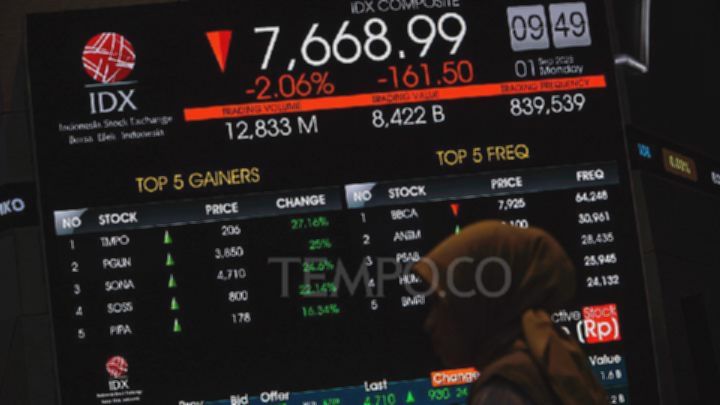

Indonesia’s financial markets concluded trading on Tuesday, May 26, 2026, ahead of the Eid al-Adha holiday, facing significant headwinds. The Jakarta Composite Index (IHSG) experienced a notable decline, plummeting to 6,130.19. Concurrently, the rupiah’s exchange rate also registered a weakening, losing 52 points against the robust United States dollar.
According to data from the Indonesia Stock Exchange, the IHSG’s performance at the close of today’s session marked a 1.23 percent drop compared to the previous day’s closing figures. This downturn was observed amidst active trading, with a total transaction value reaching Rp 18.09 trillion. The market saw a high trading frequency of 1.96 million times, involving a substantial trading volume of 24.88 billion shares.
Further reflecting the market’s unease, the spot rupiah closed weaker by 52 points, settling at Rp 17,795 per US dollar. Looking ahead, currency observer Ibrahim Assuaibi offered a cautious forecast, predicting that the rupiah exchange rate would exhibit volatility but ultimately close weaker on the following day. He projected the currency to trade within a range of Rp 17,790 to Rp 17,850 per US dollar in his routine analysis issued on the same Tuesday, May 26, 2026.
This weakening of the Indonesian rupiah is largely attributed to the simultaneous strengthening of the US dollar index. A dominant global factor influencing this trend remains the persistent conflict in the Middle East. Recent reports indicate that the United States launched new attacks targeting missile launch sites and mine-laying vessels in southern Iran. US forces have justified these actions as self-defense, reiterating that a ceasefire with Iran remains in effect despite the fresh hostilities.
The precise response from Iran to these latest military actions remains uncertain. However, Ibrahim highlighted that any new military engagement carries the potential to complicate the delicate and ongoing peace negotiations between the two nations. He specifically noted the heightened tension, especially given Tehran’s repeated warnings to the US against further offensive strikes, underscoring the fragile nature of regional stability.
On the domestic front, Ibrahim pointed to an emerging crisis of confidence, which is beginning to manifest as an economic crisis, directly stemming from the rupiah’s depreciation against the US dollar. He emphasized that there is currently no clear prediction for when the intense pressure on the Indonesian currency might alleviate, signaling prolonged uncertainty for the local economy.
This challenging economic climate is having a tangible impact, particularly on corporate balance sheets. Companies, especially those in industries heavily reliant on imported raw materials and geared towards export markets, are experiencing significantly increased production costs. This adverse situation, Ibrahim warned, consequently elevates the risk of widespread layoffs, posing a serious threat to employment stability across various sectors.
Editor’s Choice: How Investors Should Respond to MSCI Assessment