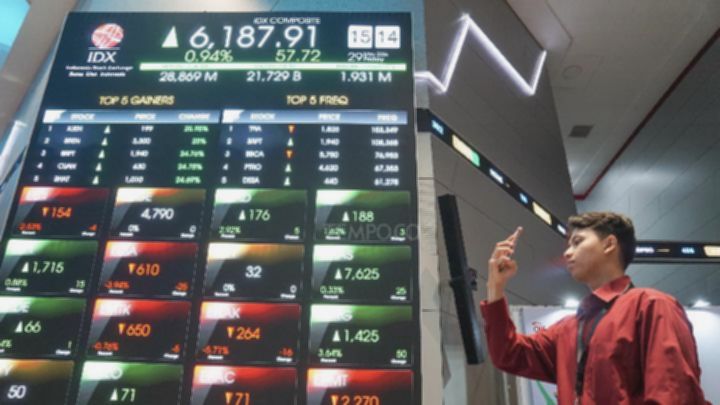

The Jakarta Composite Index (JCI) closed higher on Tuesday afternoon, driven primarily by a surge in the energy sector. The index rose by 68.04 points, or 1.11 percent, settling at 6,195.42. Similarly, the LQ45 index, which tracks the 45 most liquid stocks, climbed 8.10 points or 1.33 percent to finish at 619.27.
Maximilianus Nico Demus, Associate Director of Research and Investment at Pilarmas Investindo Sekuritas, noted that the market’s upward momentum was supported by investors processing recent economic data. Despite the domestic gains, global sentiment remains cautious due to heightened geopolitical tensions, particularly the uncertainty surrounding US-Iran negotiations and their subsequent impact on volatile crude oil markets.
Reports indicate that Tehran has paused talks with Washington following Israeli strikes in Lebanon. This situation is further complicated by conflicting statements from US President Donald Trump, who insists that negotiations are ongoing, and Israeli Prime Minister Benjamin Netanyahu. Nico highlighted that market participants are closely monitoring these mixed signals as they navigate the shifting geopolitical landscape.
On the domestic front, economic indicators remain resilient. S&P Global reported that Indonesia’s Purchasing Managers’ Index (PMI) rose to 50.0 in May 2026, up from 49.1 in April. This reflects a robust domestic sector capable of buffering the impact of global pressures on export volumes. Meanwhile, the Central Statistics Agency (BPS) confirmed that May 2026 inflation stood at 0.28 percent month-to-month and 3.08 percent year-on-year, remaining within Bank Indonesia’s target range of 2.5 percent plus or minus 1 percent.
Trade data also showed stability, with BPS reporting a trade surplus of 90 million US dollars. This was derived from exports totaling 25.30 billion US dollars against imports of 25.31 billion US dollars.
The JCI maintained positive territory throughout the day, holding its gains from the opening bell through both the morning and afternoon sessions. According to the IDX-IC sectoral index, the energy sector led the rally with a 1.78 percent increase, supported by the infrastructure and basic materials sectors, which rose 0.64 percent and 0.58 percent, respectively.
Conversely, six sectors faced downward pressure. The transportation and logistics sector saw the steepest decline at 3.20 percent, followed by the health and property sectors, which fell by 2.65 percent and 1.13 percent.
Market activity saw 2,572,956 transactions involving 31.25 billion shares, with a total value of Rp 25.47 trillion. In terms of individual stock performance, BEER, NZIA, KUAS, DSSA, and BREN emerged as the top gainers, while TRUE, ELPI, APIC, KJEN, and EPAC recorded the sharpest declines. Overall, 281 stocks rose, 389 fell, and 147 remained unchanged.
Performance across the broader Asian region was mixed. The Nikkei index dipped by 330.33 points (0.49 percent) to 66,604.00, while the Shanghai index rose 17.36 points (0.43 percent) to 4,075.10. Meanwhile, the Hang Seng index climbed 640.14 points (2.52 percent) to 26,038.32, and the Straits Times index gained 51.13 points (1.01 percent) to 5,088.99.
Editor’s Choice: Can the JCI Strengthen After the MSCI Rebalancing? Here Are the Requirements.
Summary
The Jakarta Composite Index (JCI) closed higher, rising 1.11% to 6,195.42, primarily driven by strong performance in the energy sector. This upward movement was supported by investors processing positive domestic economic data. Global sentiment remained cautious due to geopolitical tensions, but Indonesia’s robust domestic indicators helped buffer external pressures.
Domestically, Indonesia’s Purchasing Managers’ Index (PMI) rose to 50.0 in May 2026, alongside a $90 million trade surplus and inflation within Bank Indonesia’s target. The energy sector led gains with a 1.78% increase, while transportation and logistics experienced the steepest decline. Overall, 281 stocks rose on the day, contributing to the JCI’s positive close.