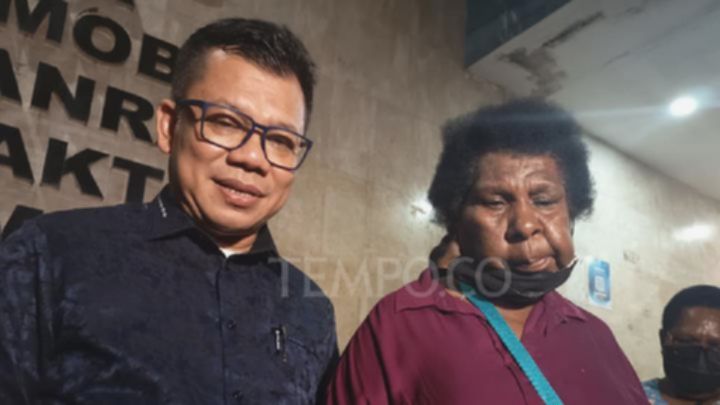

The collaborative production team behind the documentary film Pesta Babi has issued a formal response regarding the recent change in stance by Yasinta Moiwend, widely known as Mama Yasinta. As a prominent Indigenous leader of the Marind-Anim tribe in Merauke, South Papua, Mama Yasinta originally appeared in the documentary but has recently expressed significant objections to her involvement.
Addressing the situation, Johnny Teddy Wakum, Director of the Legal Aid Institute (LBH) Papua Merauke, urged the public to approach the matter with sensitivity. On Saturday, May 30, 2026, he stated, “Our team respects whatever position Mama Yasinta currently holds, and we ask the public not to corner or judge her.”
Wakum emphasized that Yasinta’s history of activism long predates the creation of the film. A respected Indigenous figure, she has been a tireless advocate for her community and their ancestral rights. Her commitment was recognized nationally when she received the S.K. Trimurti Award 2025 from the Alliance of Independent Journalists (AJI) for her brave efforts in defending Indigenous lands against the encroachment of government-led food estate projects.
Despite the current friction, the production team remains committed to reconciliation. “We have not been able to reach or meet with Mama Yasinta directly, but we are continuing our efforts to restore communication and are coordinating with her family,” Wakum added.
The controversy stems from a legal complaint filed by Yasinta with the Metro Jaya Regional Police, citing alleged violations of Article 65 in conjunction with Article 67 of Law Number 27 of 2022 concerning Personal Data Protection. The report was triggered by her appearance in the documentary, where she is featured as a farmer from Wanam, Ilwayab District, voicing opposition to regional government food and energy initiatives.
Pesta Babi serves as a critical lens through which to view the struggles of Papuan communities who feel their forests, ancestral lands, and traditional livelihoods are being systematically seized under the guise of development, food security, and energy sovereignty. In the film, director Dhandy Laksono highlights the government’s massive project to convert 2.5 million hectares of forest into palm oil plantations, sugarcane, rice fields, and livestock farms.
The film is the result of a joint effort between several organizations, including the Ekspedisi Indonesia Baru, Greenpeace Indonesia, Jubi Media, LBH Papua Merauke, Pusaka Bentala Rakyat, and Watchdoc, all of whom continue to navigate the complexities arising from the project’s documentation.
Editor’s Choice: Yasinta Moiwend Seeks Employment to Renovate Her Home
Summary
The production team behind the documentary Pesta Babi has responded to the recent legal complaint filed by Indigenous activist Mama Yasinta regarding her appearance in the film. While Yasinta, a recipient of the S.K. Trimurti Award 2025, has voiced objections and reported the creators for alleged personal data protection violations, the team maintains a respectful stance. Legal representative Johnny Teddy Wakum has urged the public to avoid judging her, emphasizing her long-standing history of activism for the Marind-Anim community.
The documentary, directed by Dhandy Laksono, documents the environmental and social impacts of large-scale government agricultural projects in South Papua. Despite the current friction, the collaborative production team, including groups like Greenpeace Indonesia and LBH Papua Merauke, remains committed to restoring communication. They are actively coordinating with Yasinta’s family to resolve the matter and address the complexities surrounding the film’s documentation of land rights issues.