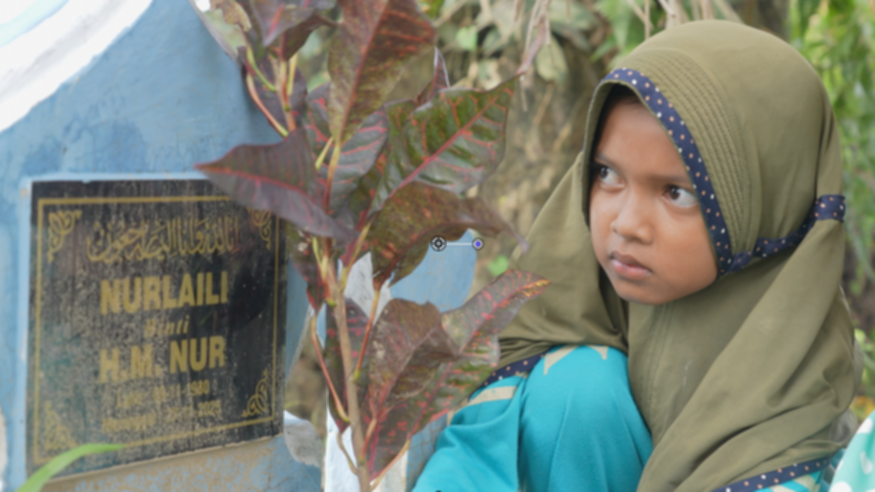

A young girl in North Aceh refuses to let grief define her future, finding the strength to carry on six months after a devastating flood and landslide claimed the lives of her mother, older brother, and grandmother.
For Sausan Sania, a ten-year-old fourth grader, the path to healing is paved with small, everyday acts: visiting the graves of her loved ones, selling toys to classmates, playing with friends, and studying diligently with the dream of one day becoming a policewoman.
This article is the second in a special BBC News Indonesia series documenting the struggles of vulnerable survivors rebuilding their lives six months after the Sumatra disaster.
Note: BBC News Indonesia received formal consent from Sausan Sania’s father and her school administration to interview her and document her daily activities.
“You are so lucky to have your mom,” Sausan told a classmate recently while watching her friend spend time with her mother. “You can be comforted, cooked for, held, and hugged by her. I don’t have a mother anymore.”
Sausan’s mother, Nurlaila, along with her eldest brother, Muhammad Zunnur, and her grandmother, Aman Husna, were swept away by flash floods in late November last year. She now lives with her father, T. Zaman Huri, her surviving older brother, and her younger sister. Her family is among the thousands affected by the catastrophe that claimed over 1,200 lives across Aceh, North Sumatra, and West Sumatra.

On a recent Friday morning at SD Negeri 6 Tanah Jambo Aye in North Aceh, the sound of children’s laughter echoed through the schoolyard. It was a stark contrast to the silence that gripped the school six months ago when floodwaters submerged nearly half the building. Despite the ongoing presence of lingering mud and water on the school grounds, life is slowly returning to normal. Nearby, a vehicle stands ready to distribute nutritious meals—a key component of President Prabowo Subianto’s flagship student program.

Sausan plays with her friends, her laughter masking the depth of her trauma. Most of the students are wearing new uniforms recently provided by the government, though some still attend class in sandals. Inside the fourth-grade classroom, there are no desks or chairs.

The students sit on the floor, listening intently to their teacher’s math lesson. When the teacher calls on her, Sausan steps forward, writing the answer on the board with quiet confidence. Lili Andasna, the school principal, notes that this resilience was hard-won. “Sausan was often withdrawn and visibly sad when she first returned to school,” Lili explains. “More than 90 percent of our students were affected by the floods. We told them, ‘We must be strong; this is a test from God.'”

As the days passed, the atmosphere at the school began to shift. The children found comfort in each other’s company and the simple joy of new uniforms. “I tell my teachers that we cannot stay down,” says Lili. “We must rise and organize our school so the children feel encouraged to learn.”

After school, Sausan returns home about a kilometer away. She keeps a book of Yasin and Tahlil prayers near her, often gazing at photos of her mother and brother. Driven by a lingering sense of longing, she frequently asks her father to take her to the gravesite, located just 400 meters from their home.

“When I miss them, I ask my father to visit,” Sausan says. “I talk to them and pray that they are at peace in heaven.” Her father, Zaman Huri, stands by her as she meticulously clears grass from the headstones.
At home, Sausan displays a small business venture—selling toys to local children. She buys them for 1,000 rupiah and sells them for 2,000, a small way to earn her own pocket money. She shyly admits that her ultimate goal is to become a policewoman, hoping to make her parents proud and honor her mother’s memory from above.

She cherishes the memory of the night before the disaster, when her family shared a meal of grilled fish and laughed together. Her last memory of her mother is a caring warning: “Eat first, my dear, in case the water rises tonight.”

A World Ending
Zaman Huri vividly recalls the morning of November 27, 2025. Persistent rains had turned the region into a death trap. “At 1:30 a.m., my son woke me up, saying the water was entering the house,” he recounts. The family fled into the darkness, but the current was relentless. As they were swept away, Zaman desperately held onto Sausan and his youngest child, while his wife and the others were separated in the chaos.

After being briefly separated from his children, Zaman spent two harrowing days clinging to a palm tree with his youngest. He describes the scene as a true “kiamat dunia”—the end of the world. Eventually, rescue came, and he learned that Sausan had miraculously survived by washing up on a banana tree. Though he lost his wife, mother-in-law, and eldest son, his duty to the remaining children keeps him moving forward despite the profound trauma that still grips their household.

Today, Zaman struggles to balance the roles of both father and mother while seeking work to support his family. “I hope for economic recovery and the strength to move past this,” he says. For Sausan, the wish is simpler: for her school to be fully restored so she can learn like any other child.
Please Help Us Rebuild
Nearly 100 kilometers away, students at SDN 5 Peusangan Siblah Krueng are still learning inside emergency tents. The original school building remains buried under thick mud and debris. Irnawati, a teacher there, watches her students study on carpets, expressing her heartbreak when they ask, “When will we have a proper school again?”

According to the Head of the Aceh Education Office, Murthalamuddin, 31 schools are currently utilizing emergency classrooms to replace hot, temporary tents. While the government has pledged significant funding—nearly 2.9 trillion rupiah for school revitalization—thousands of children and teachers across Sumatra remain affected, waiting for their classrooms to be restored to normalcy. For these children, the education they receive in tents is a testament to their resilience, but they are eager for the day they can finally return to the safety and stability of a real classroom.
Related Articles:
- Six months after the Sumatra disaster: A mother’s struggle in temporary housing
- The plight of children orphaned by the Sumatra catastrophe: What is the state’s responsibility?
- Health impacts on children in Aceh Tamiang following weeks of eating instant noodles
- Approaching Ramadan, flood victims’ homes in Aceh remain buried in mud
- Over 165,000 Sumatra flood victims still living in inadequate temporary shelters
- Dreams washed away: New Year 2026 for Sumatra flood survivors
- The specter of referendums and armed conflict behind flood management in Aceh
- Farmers struggle two months post-disaster: Thousands of hectares still covered in mud
- Government files 4.8 trillion rupiah lawsuit against companies linked to the disaster
- The survival of Tapanuli Utara durian farmers: Avoiding a new cycle of poverty
- Finding simplicity in tragedy: How floods changed a small village’s Christmas
Summary
Six months after devastating flash floods and landslides in North Aceh claimed the lives of her mother, brother, and grandmother, ten-year-old Sausan Sania continues to pursue her dream of becoming a policewoman. Despite her profound loss, she finds comfort in her daily school routine, her friendships, and visiting the graves of her loved ones. Her resilience reflects a broader movement of recovery in the region, where survivors and students are slowly rebuilding their lives despite ongoing challenges, such as damaged school facilities and the loss of essential infrastructure.
The disaster, which caused over 1,200 fatalities across Sumatra, left thousands of children like Sausan struggling to regain a sense of normalcy in the aftermath. While the government has pledged significant funding for school revitalization and relief efforts, many students still rely on makeshift classrooms and temporary tents. As families and educators strive to move forward, the focus remains on economic recovery and restoring the safety and stability of schools to support the long-term well-being of the affected children.